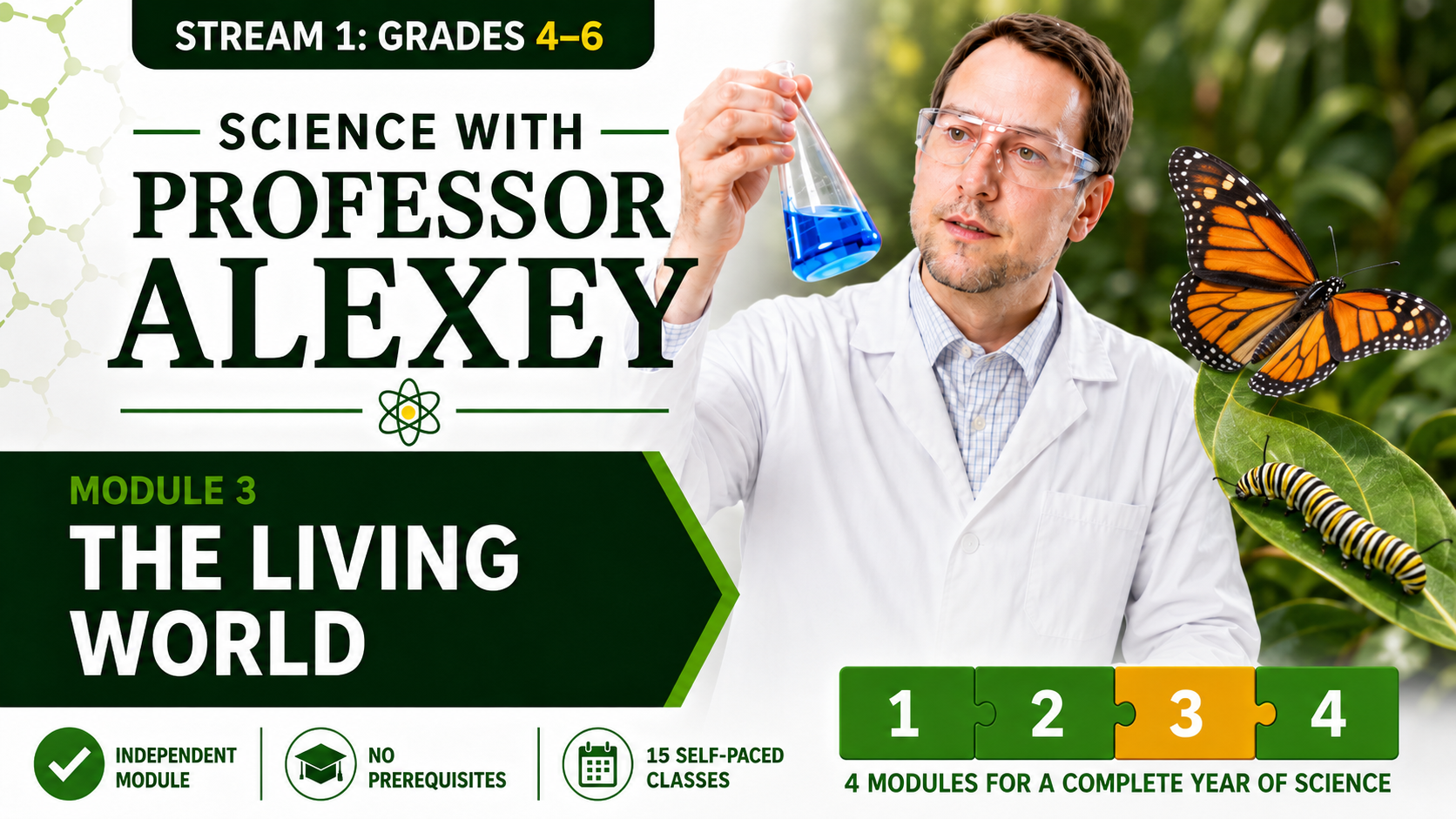
Grades 4-6 Module 3: The Living World
About Course
Available from: date TBA (2027)
Module 3: The Living World
What makes something alive? How do plants, animals, ecosystems, and the human body work and depend on one another?
In this five-week science module, students explore the remarkable diversity of life, from microscopic cells to complex ecosystems. They learn how living things are classified, how plants grow and reproduce, and how animals develop and adapt for survival. They then investigate habitats, food webs, energy flow, and relationships between organisms before examining the major systems of the human body and how they work together.
The emphasis is not on memorizing definitions. Students learn to observe carefully, test ideas with evidence, explain what they see, and recognize when more than one process may be involved.
Who is the course for?
This course is designed for homeschool students in Grades 4-6.
No previous science course is required. Core explanations are accessible to younger students, while optional Going Further readings and research questions give older or more advanced learners additional depth.
How the course works
The module contains 15 classes which can be taken at any pace; three classes per week yield a well paced five week course.
Each class includes:
- a short instructor video;
- a complete handout with structured reading-and-work lesson;
- questions and journal activities;
- a clear Words to Know glossary;
- an optional Going Further reading;
- opportunities to practise observation, measurement, explanation, and fair testing.
Most classes take approximately 30-35 minutes. Students complete hands-on experiments and investigation each week, using commonly accessible materials (no special science kits are required).
Founding Family pricing:
The discounted rate applies for registrations within 2 weeks of the enrolment opening date.
Certificates
Every student who completes the module receives a certificate of completion.
Students who complete this module together with any two additional Stream 1 science modules will also receive a certificate recognizing the completion of a full academic year of science study.
Course Content
Living Things and the Diversity of Life
-
Class 1
Plants: Structure, Growth, and Reproduction
Animals: Form, Function, and Survival
Habitats, Ecosystems, and Interdependence
The Human Body and Its Systems
Student Ratings & Reviews