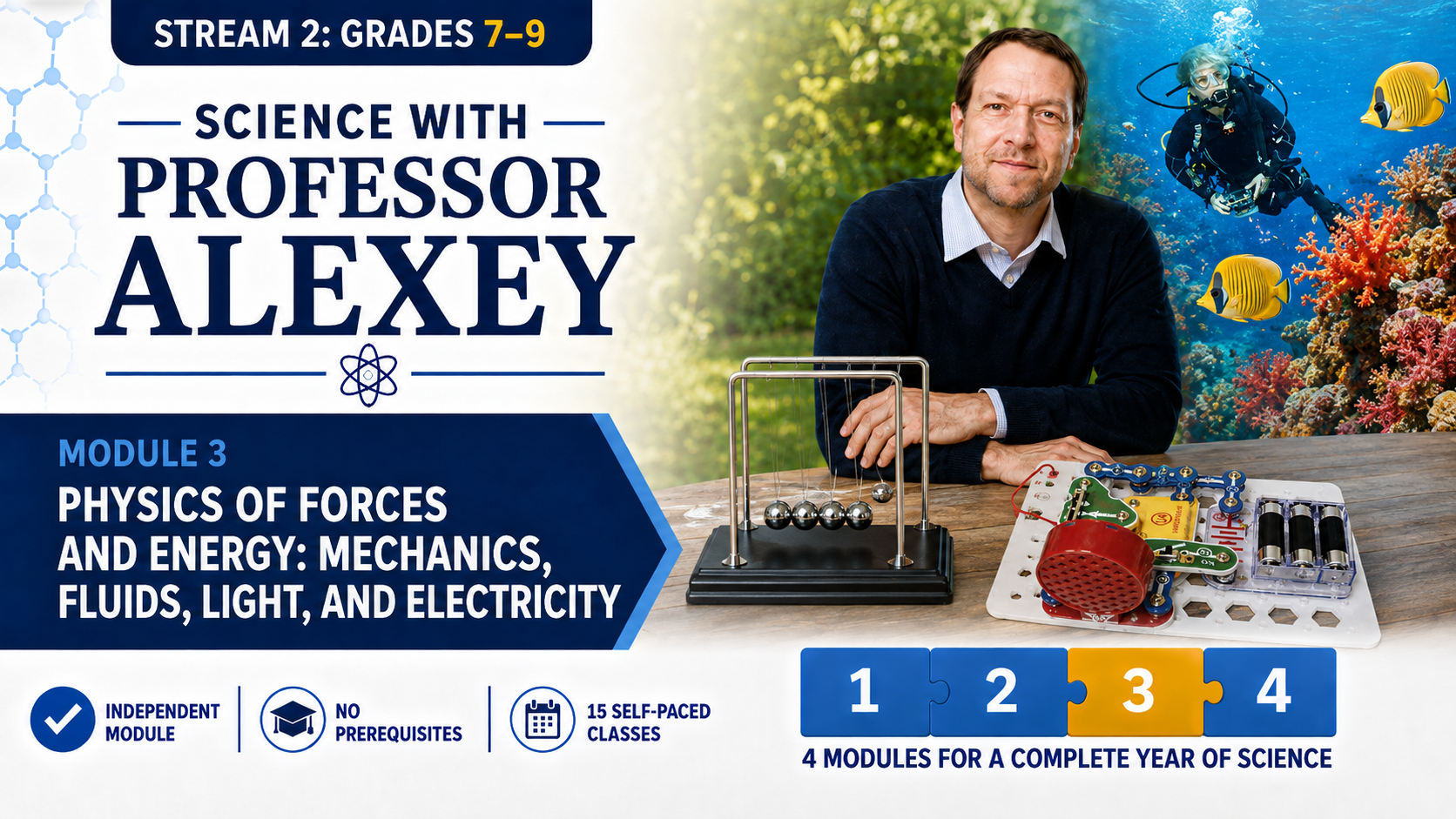
Grades 7-9 Module 3: Physics of Forces and Energy: Mechanics, Fluids, Light, and Electricity

About Course
Available from: date TBA (2027)
Module 3 – Physics of Forces and Energy: Mechanics, Fluids, Light, and Electricity
How do forces change motion? How can the same principles explain a falling object, a floating ship, an electric circuit, a beam of light, and a sound wave?
In this five-week science module, students build a connected understanding of mechanics, energy, fluids, electricity, light, and sound. They apply Newton’s laws, vectors, work, kinetic and potential energy, pressure, buoyancy, and conservation principles to real situations. Through quantitative investigations, they measure friction, energy loss, heat transfer, current, voltage, resistance, electrical power, refraction, magnification, and the speed of sound.
Who is the course for?
This course is designed for homeschool students in Grades 7-9.
No previous science course is required. Core explanations are accessible to younger students, while optional Going Further readings and research questions give older or more advanced learners additional depth.
How the course works
The module contains 15 classes which can be taken at any pace; three classes per week yield a well paced five week course.
Each class includes:
- a short instructor video;
- a complete handout with structured reading-and-work lesson;
- questions and journal activities;
- a clear Words to Know glossary;
- an optional Going Further reading;
- opportunities to practise observation, measurement, explanation, and fair testing.
Most classes take approximately 45-55 minutes. Students complete hands-on experiments and investigation each week, using commonly accessible materials (no special science kits are required).
Founding Family pricing:
The discounted rate applies for registrations within 2 weeks of the enrolment opening date.
Certificates
Every student who completes the module receives a certificate of completion.
Students who complete this module together with any two additional Stream 1 science modules will also receive a certificate recognizing the completion of a full academic year of science study.
Course Content
Forces and Motion
-
Class 1
nergy and Its Conservation
Fluids: Density, Pressure, and Buoyancy
Chemical and Electrical Energy
Light and Sound
Student Ratings & Reviews