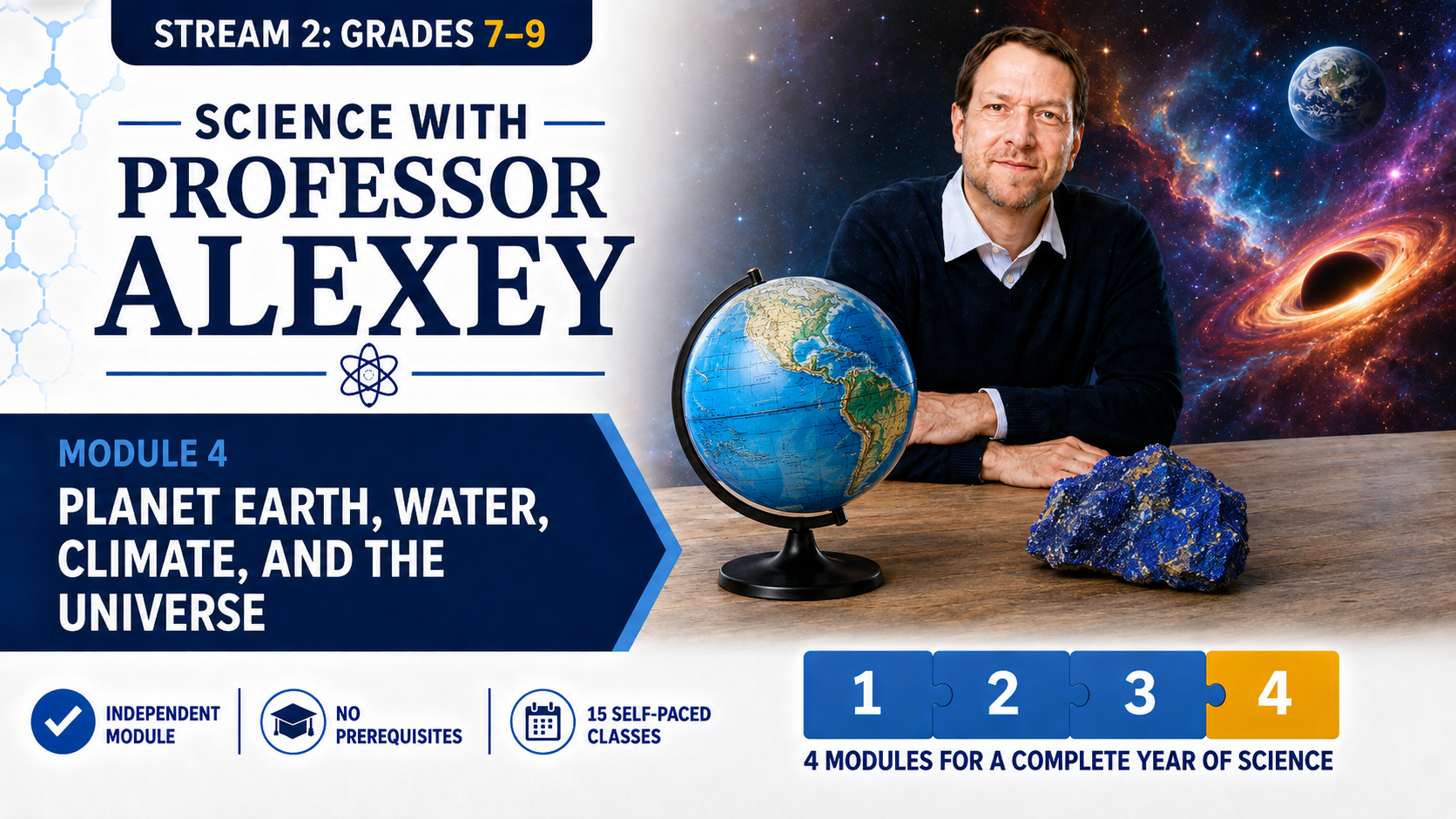
Grades 7-9 Module 4: Planet Earth, Water, Climate, and the Universe

By Prof. Alexey Categories: Science
Wishlist Share

About Course

Available from January 15, 2027:

Module 4: Planet Earth, Water, Climate, and the Universe
How do we know what lies inside the Earth, or how distant stars and galaxies behave? How can scientific models connect Earth’s rocks, water, atmosphere, climate, and place in the universe?

In this five-week science module, students investigate Earth and space as dynamic, interconnected systems. They study minerals, rocks, fossils, plate tectonics, geological time, earthquakes, volcanoes, water systems, the atmosphere, and global weather patterns. They then explore planetary motion, gravitation, stars, galaxies, the red shift, and the expanding universe before building a computational model that turns scientific ideas into a testable simulation.

Who is the course for?

This course is designed for homeschool students in Grades 7-9.

No previous science course is required. Core explanations are accessible to younger students, while optional Going Further readings and research questions give older or more advanced learners additional depth.

How the course works

The module contains 15 classes which can be taken at any pace; three classes per week yield a well paced five week course.

Each class includes:

  • a short instructor video;
  • a complete handout with structured reading-and-work lesson;
  • questions and journal activities;
  • a clear Words to Know glossary;
  • an optional Going Further reading;
  • opportunities to practise observation, measurement, explanation, and fair testing.

Most classes take approximately 45-55 minutes. Students complete hands-on experiments and investigation each week, using commonly accessible materials (no special science kits are required).

Founding Family pricing:

The discounted rate applies for registrations within 2 weeks of the enrolment opening date.

Certificates

Every student who completes the module receives a certificate of completion.

Students who complete this module together with any two additional Stream 1 science modules will also receive a certificate recognizing the completion of a full academic year of science study.

Show More

What Will You Learn?

  • You will learn how rocks, fossils, seismic waves, magnetic fields, weather records, radiation, and light reveals Earth’s history and the structure of the universe. You will also explore plate tectonics, atmospheric circulation, orbits, stellar evolution, climate and weather patterns, and computational modelling.

Course Content

Rocks, Minerals, and Earth’s Crust
The Earth's layered interior, deduced from the planet's average density and from the behaviour of seismic waves. Identifying minerals by hardness, streak, and density; the three rock families; and the rock cycle. Fossils and sedimentary layers as records of the past, Earth's mineral resources, and geological testing using household materials.

  • Class 1

Plate Tectonics, Geological Time, and Catastrophes
Continental drift and plate tectonics, the three types of plate boundary, and mantle convection as the driving engine, with seafloor magnetic stripes as the decisive evidence. Relative dating from rock layers and absolute dating by radioactive half-life, and how the age of the Earth is measured. Earthquakes, volcanoes, tsunamis, and impacts, with magnitude as a logarithmic scale.

States of Matter and Thermal Changes (copy)
How particles are arranged and move in solids, liquids, and gases. Melting, freezing, evaporation, boiling, and condensation. The difference between heat and temperature, how thermal energy moves, and how insulation works.

Water Systems, the Atmosphere, and Weather
The distribution of Earth's water, the water cycle. Weathering, erosion, and deposition that shape the land. Air as moving molecules: the Celsius, Fahrenheit, and Kelvin temperature scales, absolute zero, molecular speed, and pressure as molecular collision. Convection as the weather engine, Hadley cells and jet streams in atmosphere, and reading and drawing real weather maps.

The Solar System, Stars, and the Universe
The solar system and its true scale, gravitation, and the extreme atmospheres of other planets. Orbits as continuous falling, orbital and escape speeds, transfer orbits, gravity assists, and the centre of mass. The birth and death of stars, the Milky Way, look-back time, red shift, and Hubble's law for an expanding universe.

Earth Systems and Computational Modelling
The geosphere, hydrosphere, atmosphere, and biosphere as one interacting system, with matter cycling and energy flowing through. What a scientific model is, how a physical law becomes a running simulation, and a computational project in which students build and test a model of their own.

Student Ratings & Reviews

No Review Yet
No Review Yet

Want to receive push notifications for all major on-site activities?